Why Nurses Skipping Meal Breaks Isn't Really a Willpower or Discipline Problem
Quick Answer: Nurses skip meal breaks because a break physically requires another qualified person to cover the assignment — that’s a staffing condition, not a discipline problem. No amount of personal resolve creates coverage that doesn’t exist. The productive move is documenting the pattern and raising it with charge or management as a coverage and safety issue, not a time-management one.
You’ve been told to prioritize yourself. To set boundaries. To be better about taking your thirty.
Here is what actually happened at 1:40 today: you had five patients, one was decompensating, the person who’d cover you was in an admission, and there was no version of walking away that was safe.
That is not a willpower failure. That’s arithmetic.

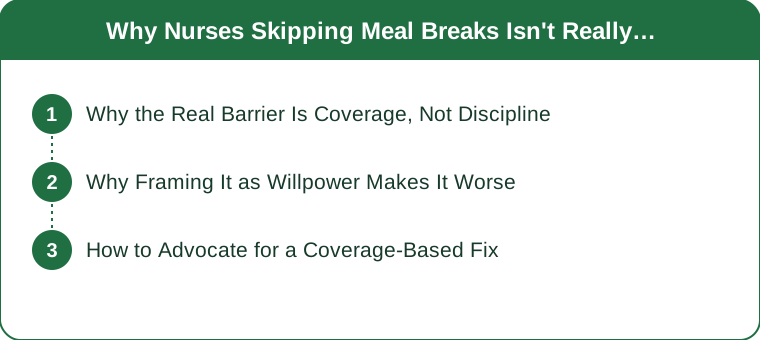
Why Can’t Nurses Just Take Their Breaks?
Because a break has a hard precondition that has nothing to do with you.
For a nurse to step away, another qualified person has to accept responsibility for the full assignment during that window. Not be nearby. Not be willing in principle. Actually available, actually qualified, and actually not already carrying their own full load.
That precondition depends on the unit’s staffing ratio, the acuity mix on that particular shift, whether anyone called out, and whether the charge nurse is already covering three other holes. Every one of those variables sits above the individual nurse in the org chart.
You can want the break intensely. You can have excellent boundaries. If nobody can take the assignment, the break does not exist as an option.
There’s a second constraint that gets ignored: breaks are also unpredictable in timing. Even when coverage exists at 12:00, it may not at 12:20 when the admission lands. So “just take it earlier” runs into the same wall from a different angle.

Why Does Calling It a Discipline Problem Make It Worse?
Because it adds guilt to a logistics problem, and guilt doesn’t create staffing.
When a structural gap gets framed as a personal failing, three things happen, none of them good:
The nurse absorbs blame for something outside their control. That’s a reliable ingredient in burnout — the combination of high demand, low control, and personal responsibility for outcomes you can’t influence.
The real problem stays invisible. If missed breaks are logged as individual behavior, they never appear as a staffing signal. Nothing in the system learns anything.
It suppresses reporting. People don’t escalate what they’ve been told is their own shortcoming. So the data that would justify another float nurse never gets collected.
Meanwhile the downstream costs are real and measured: fatigue and missed breaks are associated with higher rates of medication errors and needlestick injuries, and skipped breaks correlate with intent to leave the profession. This is a patient safety variable that’s being filed under self-care.
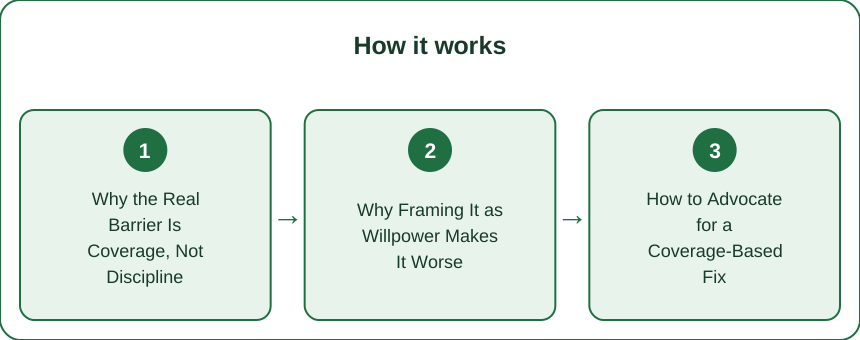
How Do You Actually Advocate for Break Coverage?
Move the conversation from your character to the schedule. Specific steps:
1. Document the pattern, not the incident. Keep a simple log: date, shift, whether a break was taken, whether coverage was available, patient count and acuity. Four weeks of entries is a data trail. One bad Tuesday is an anecdote, and anecdotes get answered with sympathy instead of staffing.
2. Use your facility’s actual reporting mechanism. Most systems have a missed-break attestation, a staffing variance form, or an incident reporting pathway. Filing through the formal channel puts the event in a database where it can be counted. Verbal complaints don’t aggregate.
3. Frame it as coverage and safety. “On 14 of the last 20 shifts there was no qualified coverage available for breaks on this unit” is an operational statement someone has to respond to. “I’m having trouble taking my breaks” invites a conversation about your time management.
4. Bring a specific proposal. A designated break relief nurse for the shift, a staggered break schedule assigned at huddle, a buddy system where two nurses formally cover each other at set times. Concrete asks get answered; general concerns get acknowledged.
5. Go collectively where you can. A pattern across six nurses on a unit is a staffing finding. One nurse raising it is easier to file as an individual issue. Your union rep or shared governance council exists for exactly this.
6. Know your state’s rules. Meal and rest break requirements for healthcare workers vary considerably by state, and some have specific provisions and penalties for missed breaks in nursing. Knowing whether your missed break is also a compliance issue changes the weight of the conversation entirely.
What Nobody Tells You About the Individual-Level Advice
Hydration reminders, snack drawers, and “step outside for 90 seconds” tips are not worthless — they genuinely help you survive a shift where coverage never materialized.
But it’s worth being clear-eyed about what they are: coping strategies for an unsolved problem, not solutions to it. Keep using them. Just don’t let them become the reason the underlying gap never gets escalated, and don’t accept them as an answer when you’ve raised the actual issue.
Doing both at once is the honest position. Manage today’s shift with the small tactics; put the pattern into the system so somebody has to look at it.
FAQ
Am I legally entitled to a break as a nurse?
It depends on your state and sometimes your union contract — some states have specific meal and rest period requirements for healthcare workers with penalties for violations, while others have far weaker protections. Check your state’s labor department guidance and your facility’s policy, because the answer materially changes what leverage you have.
What if my manager says taking breaks is my responsibility?
Ask, in writing, what the coverage plan is — specifically, who is assigned to relieve you and at what time. That single question moves the responsibility from a vague expectation to a concrete staffing decision, and the answer (or the absence of one) is itself documentation.
Does documenting missed breaks actually change anything?
Not always immediately, and not from one person. What it reliably does is convert an invisible pattern into countable data, which is the precondition for any staffing change — and in facilities with meal-break penalty pay or state reporting requirements, documented misses carry direct financial and regulatory weight.
General workplace information, not legal advice. For questions about your rights, consult your union representative, your HR department, or an employment attorney in your state. If shift stress is affecting your health or wellbeing, your employee assistance program or a mental health professional is a good place to start.
TL;DR:
- A break requires qualified coverage to exist — that’s a staffing condition, entirely above the individual nurse
- Framing it as discipline adds guilt, hides the real signal, and suppresses the reporting that would fix it
- Missed breaks correlate with medication errors, injuries, and turnover — it’s a safety issue, not a self-care one
- Document the pattern over 4 weeks, file through the formal channel, and frame it as coverage
- Bring a specific proposal (break relief nurse, staggered schedule) and raise it collectively where possible
Keep Reading
This article is for general informational purposes only and is not medical advice. Always consult a qualified health professional for guidance specific to you.