Why Hydration on Shift Fails Even When You Bring the Bottle
Quick Answer: Drinking gets deferred on shift for four structural reasons: the bathroom cost of drinking is high and unpredictable, thirst signalling is suppressed by sustained activity and stress, drinking is not attached to any fixed cue in the way meals are, and the bottle is usually somewhere you cannot reach during the tasks where you would notice it. The fix is not willpower or a bigger bottle - it is front-loading before the shift, attaching drinking to existing fixed events, and accepting the bathroom trade-off rather than solving hydration around it.
The bottle is not the problem. The bathroom math is, and everyone does it without noticing.

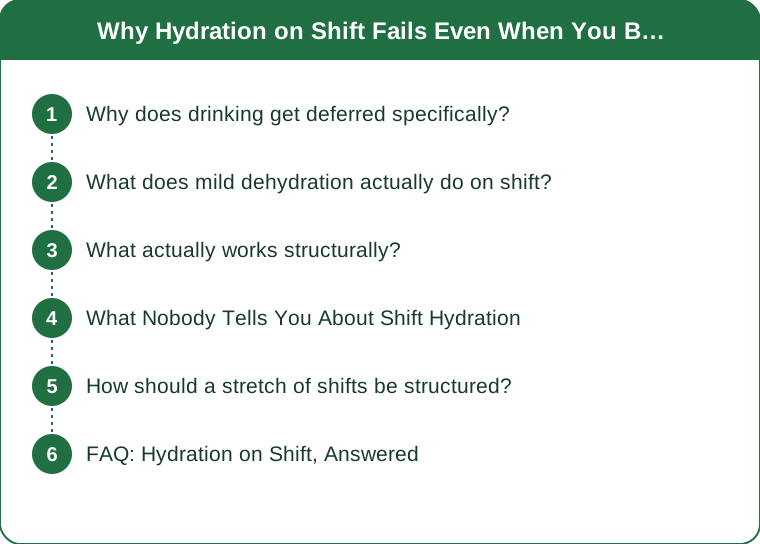
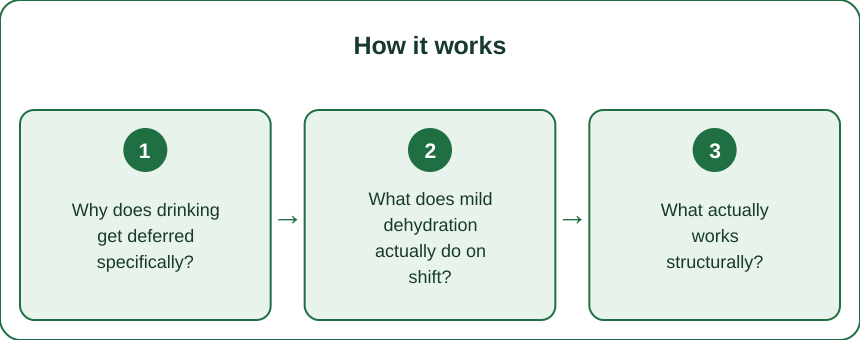
Why does drinking get deferred specifically?
The bathroom cost is real and unpredictable. Drinking now means needing a break in ninety minutes that may not be available, and the brain does that calculation continuously without surfacing it.
Thirst is suppressed during sustained activity and stress. Sympathetic activation reduces thirst perception, so a busy shift genuinely produces less thirst signal at the same level of fluid loss.
Drinking has no fixed cue. Meals have designated times, however compressed. Fluid has none, so it depends on remembering, and remembering is the resource in shortest supply.
The bottle is usually in a break room or a bag, physically separated from the work, and the moments you would notice thirst are the moments you are furthest from it.
Interruption is constant, so a drink started often does not get finished, and a half-finished drink registers subjectively as having drunk.
And the cumulative deficit builds across a stretch. Three consecutive shifts each ending mildly dehydrated compound, which is why day three feels categorically worse than day one.
What does mild dehydration actually do on shift?
Cognitive effects appear before thirst does - attention, short-term memory, and decision speed all degrade at fluid deficits well below the level that produces obvious symptoms.
Headache is the most common presentation, and it is routinely attributed to the shift itself rather than to fluid status.
Perceived exertion rises, so the same physical work feels harder, which is a substantial part of why hour ten feels so different from hour two.
Mood and irritability shift measurably, which matters in a job that is largely interpersonal.
Constipation and urinary symptoms follow over repeated shifts, and urinary tract infections are more common in populations that habitually restrict fluid.
And the recovery lag matters. Rehydrating after a shift does not immediately restore function - starting the next shift already behind is the actual mechanism behind the day-three crash.
What actually works structurally?
Front-load before the shift. Sixteen to twenty ounces in the ninety minutes before you clock in, when the bathroom is available and the cost is zero.
Attach drinking to events that already happen. Every handover, every time you wash your hands at a station near your bottle, every time you sit to chart. Existing fixed events are the only reliable cues on a shift.
Keep the bottle where you actually are. A second smaller bottle at the workstation beats one large one in the break room, because proximity beats capacity.
Drink deliberately during breaks rather than only eating. Breaks are the one guaranteed window and they are usually spent entirely on food.
Use a marked bottle with time targets if you respond to that - visible progress works for a lot of people and costs nothing.
And accept the bathroom trade-off explicitly. Deciding in advance that you will take the break is what breaks the deferral loop, because the loop is driven by an unexamined calculation.

What Nobody Tells You About Shift Hydration
Coffee is not the villain it is made out to be. Moderate caffeine intake in habitual users contributes net fluid, and the diuretic effect is modest. Coffee is a poor primary hydration source but it does not put you in deficit.
Electrolytes matter on long shifts in warm units. Plain water alone across twelve active hours in a warm environment is not always sufficient, and a small amount of sodium improves retention.
Air conditioning is dehydrating in a way people do not associate with fluid loss - low humidity increases respiratory and skin water loss without any sensation of sweating.
Masks make it worse in two ways - they increase perceived effort and they add a physical barrier that makes drinking a deliberate act requiring removal.
Night shift is the worst case. Circadian effects on fluid regulation, reduced access to breaks, and a general tendency to substitute caffeine for water all compound overnight.
And restricting fluid to avoid bathroom breaks is associated with genuine health consequences in shift-working populations, particularly urinary and kidney effects. This is general information, not medical advice - persistent symptoms warrant a doctor rather than a bigger bottle.
How should a stretch of shifts be structured?
Rehydrate deliberately after each shift, not just when thirsty. The post-shift window is where the deficit for the next shift is either cleared or carried.
Watch urine colour on days two and three, which is the practical field test - pale straw is the target and it is a better indicator than how you feel.
Front-load before every shift in the stretch, not just the first.
Increase electrolytes across a long stretch in warm conditions, particularly if you sweat noticeably in scrubs.
Do not rely on catching up on days off. The deficit accumulates within the stretch and affects performance during it, which is when it matters.
And treat this as a system problem rather than a personal one. Where breaks are genuinely unavailable, that is a staffing and safety issue worth raising rather than a habit to optimise around. This is general information, not medical advice.
FAQ: Hydration on Shift, Answered
How much should I be drinking on a twelve-hour shift?
It varies with body size, unit temperature, and workload, but most people need substantially more than they manage. Urine colour is a more practical guide than a fixed number.
Does coffee count?
Partly. In habitual users the diuretic effect is modest and moderate intake contributes net fluid. It is a poor primary source but not a negative one.
Do I need electrolytes or is water enough?
Water is usually enough for a standard shift. Long shifts in warm units, or heavy sweating, benefit from added sodium for better retention.
Why do I get headaches by hour eight?
Mild dehydration is a common contributor, along with skipped meals, caffeine timing, and sustained postural load. Fluid is the cheapest one to test.
Is restricting fluid to avoid bathroom breaks harmful?
It is associated with urinary and kidney effects in shift-working populations, and it degrades cognition during the shift. It is a genuine occupational health issue.
Why is day three so much worse?
Cumulative deficit across the stretch. Each shift starts further behind, so rehydrating properly after each one is what breaks the pattern. This is general information, not medical advice.
TL;DR:
- Drinking gets deferred because the bathroom cost is unpredictable, thirst is suppressed by stress and activity, there is no fixed cue, and the bottle is out of reach.
- Mild dehydration degrades attention and decision speed before you feel thirsty, and raises perceived exertion - much of the hour-ten feeling is fluid status.
- Front-load sixteen to twenty ounces before clocking in, keep a second bottle at the workstation, and attach drinking to handovers and charting.
- Coffee is not the enemy; air conditioning, masks, and night shifts all quietly make it worse.
- Day three is worse because the deficit accumulates - rehydrate deliberately after every shift, not just the last one.
Where breaks are genuinely unavailable, that is a staffing and safety issue, not a personal habit problem. This is general information, not medical advice.
Keep Reading
This article is for general informational purposes only and is not medical advice. Always consult a qualified health professional for guidance specific to you.