Why Nurses End Shifts Dehydrated and What It Costs by Hour Ten
Quick Answer: Most on-shift dehydration is deliberate rather than accidental. Drinking means needing a bathroom, and a bathroom break is often the least available thing on a busy unit, so people ration fluids from early in the shift. The cost shows up as reduced concentration, slower reaction time, headache and worse mood, with measurable cognitive effects appearing at around 2 percent body mass loss. The workable fix is front-loading before the shift and drinking in timed small volumes, not carrying a bigger bottle.
You did not forget. You made a rational trade at 8:30am, and then again at 10, and by hour ten you have a headache and you are re-reading the same line on a chart.
The problem is structural, which also means the fix has to be structural rather than a reminder to drink more.

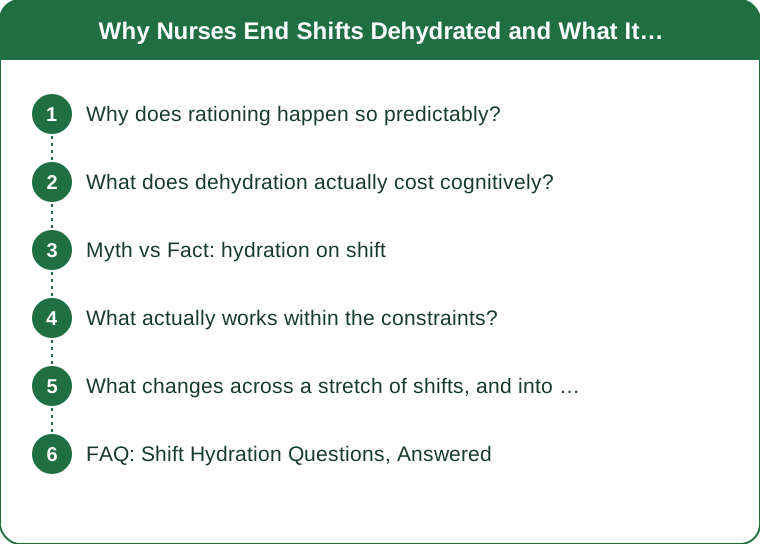
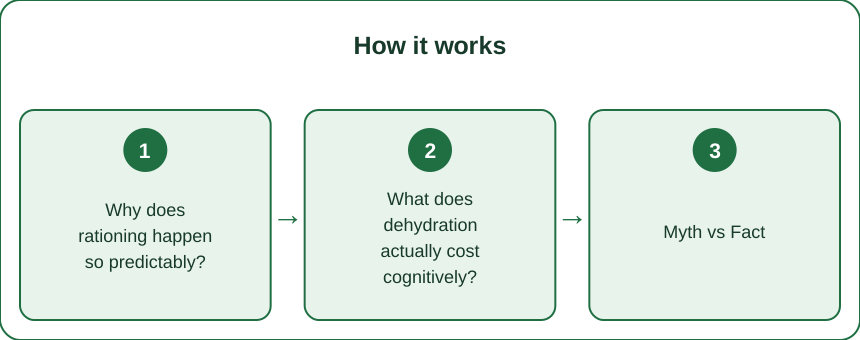
Why does rationing happen so predictably?
Because the cost of drinking is immediate and the cost of not drinking is delayed.
Bathroom access is the binding constraint. On a busy unit, leaving the floor requires handover, timing, and an absence of anything urgent. That is a real cost, paid now.
Dehydration’s cost arrives hours later, and by then it is attributed to tiredness, the shift being busy, or the third day of a stretch.
This is a straightforward asymmetry and it produces the same behaviour in almost everyone doing the job. It is not a knowledge gap. Nurses know more about hydration than nearly any other occupational group and still finish shifts dehydrated at high rates.
Several studies of healthcare staff have found substantial proportions arriving at work already inadequately hydrated and finishing shifts worse, with urine specific gravity measurements confirming it rather than relying on self-report.
Other contributors: hot units and PPE increase losses, talking constantly dries the airway, and the drinks that are available at 3am are often caffeinated, which does not help sleep afterwards.
What does dehydration actually cost cognitively?
More than the amount would suggest, and the effects are the ones that matter most in clinical work.
Around 1 to 2 percent body mass loss is where measurable effects begin in the research literature. For a 70kg person, that is roughly 700g to 1.4kg, which is well within a shift’s losses without drinking.
What has been observed at that level:
- Reduced attention and vigilance, particularly on sustained tasks.
- Slower reaction time, modest but consistent.
- Impaired short-term memory in several studies.
- Increased perceived effort, so tasks feel harder at the same workload.
- Headache, one of the most reliably reported symptoms.
- Worsened mood, including increased fatigue and irritability, which shows up at lower deficits than the cognitive effects do.
The mood and perceived-effort effects appear first, which matters because they are the ones most likely to be attributed to the shift rather than to fluid status.
Is the effect big enough to matter clinically?
The individual effects are modest. Stacked on top of a twelve-hour shift, night-time circadian dip, and day three of a stretch, they are an additional load on exactly the functions the work depends on. That is the argument, rather than any single dramatic effect.
This is general information, not medical advice.
Myth vs Fact: hydration on shift
Myth: Thirst tells you when to drink. Fact: Thirst is a lagging indicator, and it is blunted by being busy, by stress and with age. On a shift where you are focused, thirst is one of the first signals to be overridden.
Myth: Coffee dehydrates you. Fact: Moderate caffeine intake has a mild diuretic effect that is largely offset by the fluid volume of the drink itself. Coffee counts toward fluid intake. The problem with coffee on shift is timing relative to sleep, not hydration.
Myth: Eight glasses a day is the target. Fact: There is no strong evidence base for that specific figure. Requirements vary hugely by body size, activity, temperature and diet, and roughly 20 to 30 percent of intake typically comes from food.
Myth: Clear urine means well hydrated. Fact: Completely clear can indicate overdrinking. Pale straw is the usual target. Also note that B vitamins turn urine bright yellow independently of hydration.
Myth: Drinking a lot at the end of the shift makes up for it. Fact: Rehydration takes hours and large volumes are partly excreted rather than retained. It also guarantees waking to urinate during the sleep you badly need. Distribution matters more than total.

What actually works within the constraints?
Approaches that account for bathroom access rather than ignoring it.
- Front-load before the shift. 500ml in the hour before leaving home, finishing 30 minutes before. This puts you at the start line hydrated rather than already behind, and it uses the bathroom you actually have access to.
- Drink small volumes frequently rather than large ones occasionally. 150 to 200ml at a time is absorbed steadily and produces far less bladder urgency than 500ml at once. A large bottle encourages exactly the wrong pattern.
- Attach drinking to an existing routine. Every handover, every medication round, every time you sit to chart. A trigger works and a reminder does not.
- Use the bathroom whenever you are already off the floor, whether you need it or not. This removes the main deterrent for the next hour.
- Include electrolytes if you are sweating heavily, in a hot unit or in PPE. Plain water in large volumes with heavy sweat losses can dilute sodium, and a pinch of salt in food is usually enough.
- Eat foods with water content when you get a break. Fruit, yoghurt and soup all contribute meaningfully.
What about a bigger bottle?
A bigger bottle usually leads to fewer, larger drinks. A smaller bottle refilled often produces better distribution, which is what actually matters.
This is general information, not medical advice.
What changes across a stretch of shifts, and into autumn?
Two things compound, and both are worth planning for.
Deficits carry over between shifts. Rehydrating fully after a twelve-hour shift takes longer than most people give it, particularly when sleep is the priority. Arriving at shift two already down, and shift three further down, is common, and it is one reason day three feels categorically worse than day one.
The recovery window is short. Between finishing at 8pm and starting at 7am there is limited time in which to rehydrate without disrupting sleep. The practical compromise is a solid volume immediately after the shift, then tapering in the two hours before bed.
Autumn brings a specific change: heating comes on. Indoor humidity in hospitals drops significantly once heating season starts, which increases respiratory water loss and dries mucous membranes. You lose more without sweating more, which makes it less obvious.
Also, you feel less thirsty in cooler weather even when losses are similar, so the already-weak thirst signal gets weaker.
Practical adjustments as the season turns:
- Keep the same intake habit even though you feel less thirsty.
- Expect dry skin, dry eyes and hoarseness earlier in a shift, and treat those as early signals rather than as separate problems.
- Front-loading matters more in winter, since it is the intake least dependent on how you feel during the shift.
And the honest framing: this is a workplace design problem as much as a personal one. Breaks that reliably happen would fix it faster than any bottle, and it is worth raising as such rather than treating it as an individual failure.
This is general information, not medical advice. Speak to a doctor about persistent headaches, dizziness or fatigue.
FAQ: Shift Hydration Questions, Answered
Is it dangerous to hold urine through a shift?
Regularly deferring is associated with urinary tract discomfort and infection risk in occupational studies of healthcare and other break-restricted work. It is worth taking seriously rather than accepting.
Do electrolyte tablets help on a normal shift?
Usually unnecessary unless you are sweating heavily or in PPE. Normal food provides adequate sodium and potassium for most shifts.
What is the best drink to keep at the station?
Water, in a bottle with a lid you can open one-handed. Ease of use matters more than the contents for anything that has to happen fifteen times.
Why do I get headaches specifically on the drive home?
Likely a combination of accumulated fluid deficit, caffeine timing, posture and the release of concentration. Hydration is one contributor rather than the whole explanation.
This is general information, not medical advice.
TL;DR:
- On-shift dehydration is rationing, not forgetting, because bathroom access costs more than the delayed cost of not drinking.
- Effects begin around 1 to 2 percent body mass loss: attention, reaction time, memory, headache, and mood, with mood and perceived effort affected first.
- Front-load 500ml before the shift, then drink 150 to 200ml at frequent triggers rather than large volumes occasionally.
- A smaller bottle refilled often beats a large one, and using the bathroom whenever you are already off the floor removes the deterrent.
- Deficits carry across a stretch, and heating season increases losses while reducing thirst.
The most useful reframe is that this is a break-access problem wearing a hydration costume, and the personal workarounds are damage limitation rather than a fix.
This is general information, not medical advice.
Keep Reading
This article is for general informational purposes only and is not medical advice. Always consult a qualified health professional for guidance specific to you.