Why Scrub Layering Gets Harder the Week the Hospital Heating Comes On
Quick Answer: Hospital heating creates large temperature differences between zones — a heated corridor, a cooled procedure room, a cold ambulance bay — and you move between them repeatedly across twelve hours. A single warm layer fails because it cannot be removed mid-task. The workable system is a thin merino or synthetic base under the scrub top, a removable mid-layer kept at your station, and controlling the extremities, because hands and feet are where the discomfort actually concentrates.
In summer the building was one temperature and you dressed once.
Now the heating is on, the theatre is still 18°C, the ambulance bay is 4°C, and you are cycling through all three every hour.
One layer cannot solve that. A system can.

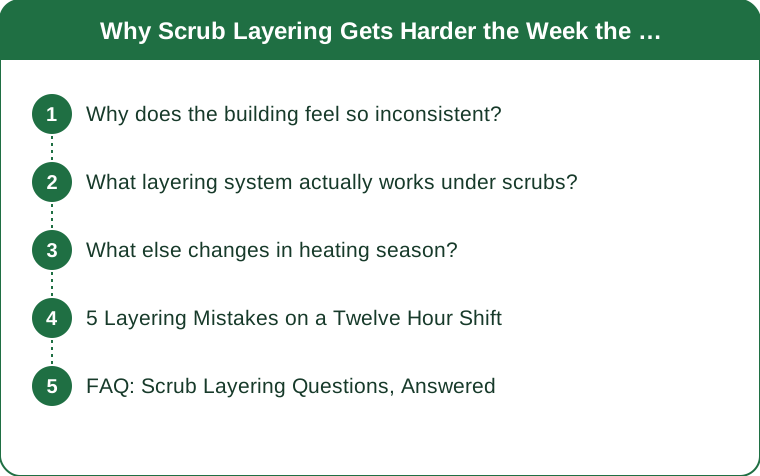
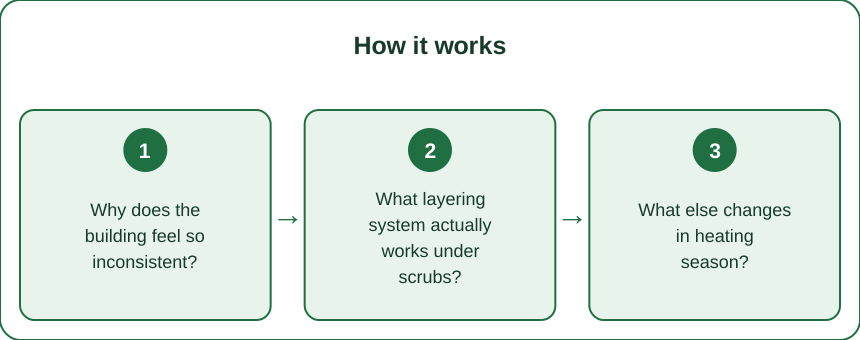
Why does the building feel so inconsistent?
Because different areas are conditioned for different purposes, and heating season widens the gaps.
Procedure and theatre spaces are kept cool deliberately. Temperature and air exchange requirements in clinical areas are set for infection control and equipment, not for staff comfort.
Corridors and offices are heated for seated occupants. So a space designed for people sitting still is uncomfortably warm for someone walking twelve kilometres a shift.
Entrance areas and bays are effectively outdoors. Doors opening constantly means these zones track outdoor temperature closely.
Air exchange rates create draughts. High air change rates in clinical areas mean moving air, and moving air feels several degrees colder than still air at the same temperature.
Your own heat output varies enormously. Ten minutes of a rapid response and you are overheating in the same clothing that had you shivering at the desk.
And the temperature difference between zones is largest in deep winter. In September the gap between a heated corridor and a cool theatre is small. In January it is substantial, which is why the system that worked in autumn stops working later.
What layering system actually works under scrubs?
Thin, removable and organised around what you can actually take off mid-shift.
A thin merino or technical base under the scrub top. Merino handles the sweat-then-cool cycle better than cotton, which holds moisture and then chills you. A long-sleeve base adds warmth with almost no bulk and stays on all shift.
A removable mid-layer that lives at your station. A thin fleece or a scrub jacket you can pull on for cold zones and drop in thirty seconds. The key requirement is that it can be removed without removing anything else.
Avoid the single warm layer. A heavy top that you cannot remove mid-task guarantees you will be overheating for half the shift.
Compression socks are doing thermal work too. Beyond their circulatory purpose, they keep feet warmer, and cold feet are the most common comfort complaint on a long shift.
Control the wrists. A base layer with a thumbhole cuff keeps the wrist covered, and the wrist is a significant heat loss point with a lot of surface blood flow.
Cotton is the wrong base layer in a heating-season hospital. It holds sweat, dries slowly and then chills you in the next cold zone. This is the single most common mistake.
Check your employer’s policy first. Rules on undershirts, sleeve length, colour and what may be worn over scrubs vary by unit and by trust, and infection control requirements take precedence over comfort.

What else changes in heating season?
Skin, hydration and hands all get worse, and they compound each other.
Indoor humidity falls to 20 to 30 percent. Hands that were merely dry in summer crack in winter, and repeated hand hygiene plus low humidity is a difficult combination.
Use an emollient after every few washes, not at the end of the shift. Frequency matters more than the product. Keep one in your pocket rather than in your locker.
Fragrance-free ointments outperform lotions on cracked skin. Thicker occlusive products hold moisture in far better in dry air.
Hydration drops without you noticing. Thirst cues fall in cool weather while dry air increases fluid loss through the skin and airways. Intake needs to be deliberate rather than driven by thirst.
Static becomes an issue with synthetic layers. Low humidity plus synthetic base layers means static, which is at best annoying and occasionally a problem around sensitive equipment.
Dry airways increase throat irritation. If your voice is going hoarse faster than it did in summer, dry air is a likely contributor alongside the usual talking volume.
Seasonal note: the first week of heating season is the worst for hands, because the transition is abrupt and skin has not adapted. Starting the emollient routine before the heating comes on, rather than after your hands crack, saves several weeks of discomfort. This is general information, not medical advice — persistent skin breakdown should be assessed occupationally.
5 Layering Mistakes on a Twelve Hour Shift
Wearing a cotton t-shirt as a base layer. It absorbs sweat, dries slowly and chills you in the next cold area. Merino or a technical synthetic is a genuine upgrade.
Choosing one warm layer instead of two thin ones. Two thin layers give you three configurations. One warm layer gives you one, and you will be wrong for half the shift.
Ignoring the feet. Cold feet dominate the experience of a long shift far more than a cold torso does. Proper socks are the highest-return item.
Leaving the mid-layer in the locker. If it is not within thirty seconds of you, you will not go and get it, and you will be cold for two hours instead.
Skipping hand care until the skin cracks. Prevention takes seconds; treating cracked hands takes weeks and hurts through every hand hygiene moment.
And the seasonal one: dressing for the outdoor commute rather than the building. You will spend twelve hours inside and twenty minutes outside. Dress for inside and carry the coat.
FAQ: Scrub Layering Questions, Answered
Can I wear a long sleeve under scrubs?
Policies vary by unit and by employer, particularly in clinical areas with bare-below-the-elbow requirements. Check your local policy before building a system around it.
Merino or synthetic base layer?
Merino handles the sweat-then-cool cycle better and resists odour over a long shift. Technical synthetics are cheaper and dry faster. Both beat cotton.
How do I stay warm without bulk?
Thin base layer, thumbhole cuffs, proper socks, and a removable mid-layer nearby. Bulk is rarely the answer; layer count is.
Why are my hands so much worse in winter?
Low indoor humidity plus frequent hand hygiene. Apply an emollient throughout the shift rather than only at the end.
Do compression socks help with cold feet?
They generally help with both circulation and warmth over a long shift. Fit matters — they should be snug, not painful.
What about the commute?
Dress for the twelve hours inside and carry the outdoor layer. Wearing a heavy coat-appropriate outfit indoors is uncomfortable all shift.
TL;DR:
- Heating season widens the gaps between zones — heated corridors, cool theatres, cold bays, all in one hour.
- One warm layer fails because you cannot remove it mid-task. Build a system, not an outfit.
- Thin merino or technical base + removable mid-layer kept within thirty seconds of you.
- Never cotton as a base — it holds sweat and chills you in the next cold zone.
- Start the hand emollient routine before the heating comes on, not after the cracking.
Check your unit’s policy first — infection control rules come before any of this.
Keep Reading
This article is for general informational purposes only and is not medical advice. Always consult a qualified health professional for guidance specific to you.