Specific Carbohydrate Diet Recipes for Nurses: Shift Meals That Actually Travel
Quick Answer: The specific carbohydrate diet works on shift if you build around three things that travel well: cooked vegetables with olive oil, plain proteins, and hard cheeses or homemade yogurt. Prep two components rather than complete meals, pack in glass, and assume you may get no microwave and a 12-minute break. Cold-servable food is the whole strategy.
Most SCD recipe collections assume a kitchen, a stove, and time. A nurse working three twelves has none of those between 7am and 7:30pm. Here’s what actually survives a shift.

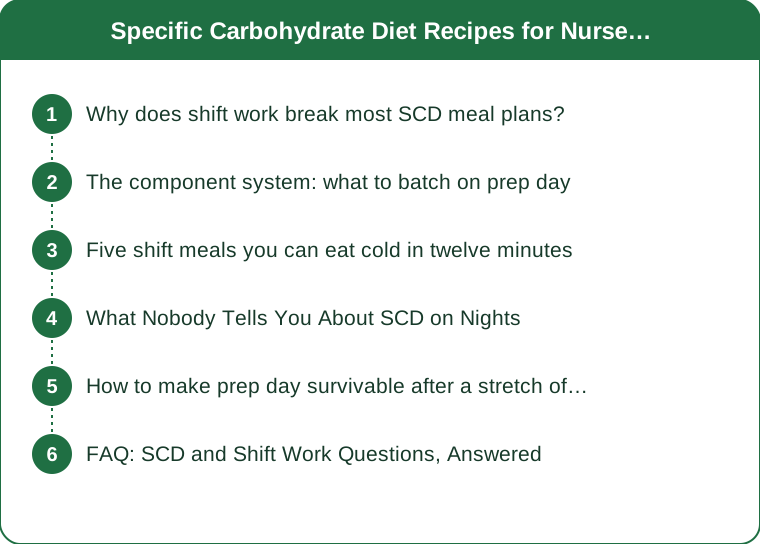
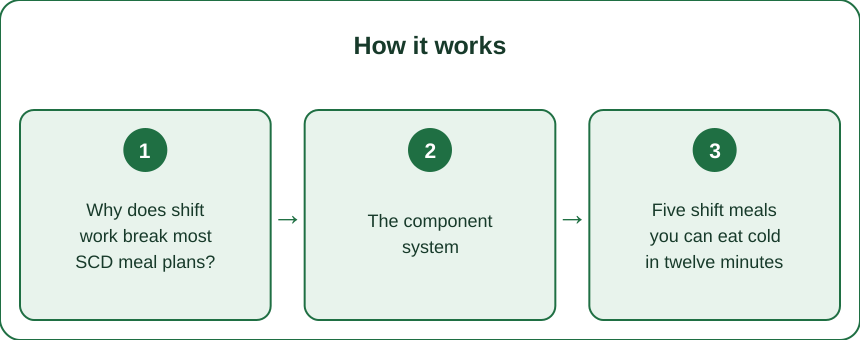
Why does shift work break most SCD meal plans?
Three collisions, and they compound.
No reliable reheating. Break room microwaves are shared, occupied, or broken. Any plan that depends on hot food arriving hot is a plan that fails on a busy Tuesday.
Unpredictable break timing. You may eat at 11am or at 3pm or in two seven-minute fragments. Food that degrades - anything that goes soggy, separates, or has to be eaten immediately - doesn’t survive that uncertainty.
The prep-day problem. SCD eliminates most convenience carbohydrates, which means more cooking from scratch at exactly the point in the week when a nurse has the least energy. Sunday-after-a-stretch is not a reliable cooking window.
The fix for all three is the same: prep components, not meals. Roast a tray of vegetables, cook a batch of protein, portion a fat and an acid. Assemble in 90 seconds each morning. Components tolerate delay and combination; complete meals don’t.
The component system: what to batch on prep day
Ninety minutes, once or twice a week, produces the entire rotation.
Vegetables (one large tray, roasted). Zucchini, carrots, green beans, bell peppers, and butternut squash all roast well and hold four days cold. Toss with olive oil and salt at 200C for 30-35 minutes. Cook them further than you would for a hot meal - properly soft roasted vegetables are far better cold than barely-done ones.
Protein (two batches). Roast chicken thighs and hard-boiled eggs cover most of the week. Thighs stay tender cold in a way breast does not. Six eggs takes eleven minutes and covers three breakfasts.
A fat and an acid. Olive oil in a small bottle and half a lemon, or a jar of dressing made from olive oil, lemon, salt, and a spoon of honey. This is what turns cold components into food you actually want to eat.
One sweet component. Baked apples with cinnamon, or a batch of almond-flour muffins, cover the 3am shift craving that otherwise ends in a vending machine.
Five shift meals you can eat cold in twelve minutes
1. The tray bowl. Roasted vegetables, sliced chicken thigh, olive oil and lemon, a scatter of hard cheese. Assembles in a minute, needs no heat, and is the backbone of the whole rotation.
2. Egg and vegetable box. Three hard-boiled eggs, cold roasted carrots and green beans, salt, olive oil. The most portable option and the one that survives being eaten in fragments.
3. Chicken and squash mash. Roasted butternut mashed with olive oil, chicken on top. Eats like comfort food at room temperature, which very little SCD food does.
4. Yogurt with baked apple. If you make 24-hour homemade yogurt, this is the closest thing to a normal snack the diet allows. Cinnamon and a spoonful of honey.
5. The salad that isn’t sad. Roasted vegetables over raw greens with a heavy dressing and plenty of protein. The heavy dressing is doing the work - underdressed SCD salads are why people abandon this.

What Nobody Tells You About SCD on Nights
Night shift changes the problem in ways day-shift advice ignores.
Your digestion is on a different clock than your schedule. Gut motility follows circadian rhythm, which doesn’t fully flip just because you’re awake. Large meals at 2am sit heavier than the same meal at 2pm for most people. Smaller, more frequent portions work better on nights even if you eat the same total.
Hydration displaces food. Nurses chronically under-drink on shift, and mild dehydration reads as hunger and as fatigue. A 750ml bottle you actually finish before your second break solves more 3am cravings than any recipe.
The post-shift meal is the one that derails people. You get home at 8am exhausted, the fridge has components that need assembling, and takeaway is one tap away. Keep one fully assembled meal - not components - in the fridge specifically for post-shift. It’s the only meal worth pre-assembling.
The break room is a social pressure engine. Shared birthday cake and doughnut boxes are constant. Having something you genuinely like in your own container beats willpower every single time.
And the honest caveat: SCD is a restrictive therapeutic diet usually followed for a diagnosed condition, ideally alongside a doctor or a dietitian who knows your case. This is general information, not medical advice, and it’s not a reason to start an elimination diet on your own.
How to make prep day survivable after a stretch of shifts
The plan that fails is the one requiring 90 fresh minutes on your worst day.
Split it. Forty-five minutes on two different days beats ninety on one. Vegetables one day, protein the next - both keep four days.
Overlap with dinner. Roast a double tray while you’re already cooking for yourself. The marginal effort is nearly zero; the marginal output is three shift meals.
Keep a two-meal emergency buffer in the freezer. Portioned, labeled, SCD-compliant. It exists purely for the week where prep doesn’t happen, and it’s what keeps a bad week from becoming a bad month.
Use one container type. Matching glass containers with the same lids removes a small daily decision and stops the lid-hunting that makes packing feel like a chore. Small friction is what actually ends meal prep habits, not big obstacles.
FAQ: SCD and Shift Work Questions, Answered
Can I do this without homemade yogurt?
Yes. Yogurt is the most time-consuming SCD staple and plenty of people skip it. Hard aged cheeses cover a similar gap with no prep at all.
How long do roasted vegetables actually keep?
Four days refrigerated in glass is a reasonable working limit, and they should be cooled before sealing. If a stretch runs longer, roast twice.
What do I do when there’s genuinely no time to eat?
Keep a shelf-stable backup in your bag - nut butter packets or SCD-compliant nuts. Not a meal, but it prevents the 4pm collapse that ends in whatever’s in the vending machine.
Is it worth telling colleagues about the diet?
A one-sentence version usually reduces the constant offering more than saying nothing does. You don’t owe anyone a medical explanation.
TL;DR:
- Prep components, not complete meals - they tolerate unpredictable breaks
- Assume no microwave; build everything to be good cold
- One tray of well-roasted vegetables plus two proteins covers most of a week
- Pre-assemble only one meal: the post-shift one
- Keep a frozen two-meal buffer for the weeks prep doesn’t happen
The diet doesn’t fail on shift because it’s hard. It fails because the recipes assume a life with a stove at 6pm.
Keep Reading
This article is for general informational purposes only and is not medical advice. Always consult a qualified health professional for guidance specific to you.