Microwave-Only Meal Prep That Actually Survives a 12-Hour Nursing Shift
Quick Answer: Build meals around microwave-safe containers with a grain, protein, and vegetable that reheat evenly in 90 seconds — avoid anything that separates, dries out, or needs stirring halfway to taste right.
You get a 20-minute break if you’re lucky, a shared microwave with a line, and zero energy to negotiate with finicky reheated food. The meals that actually work on shift are boring by design — that’s the point.

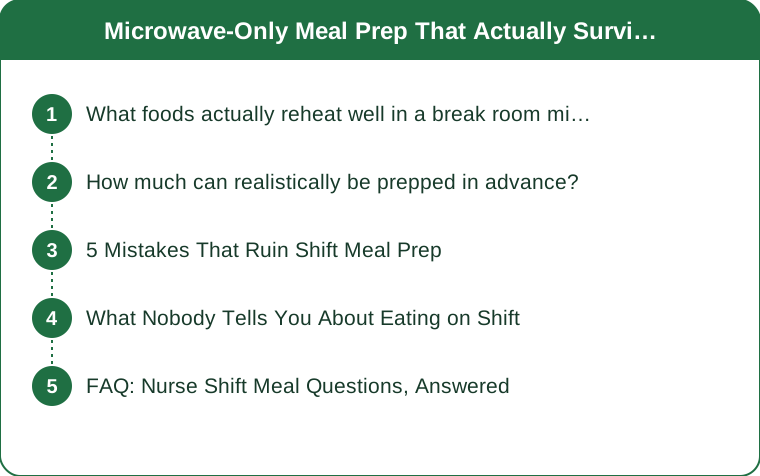
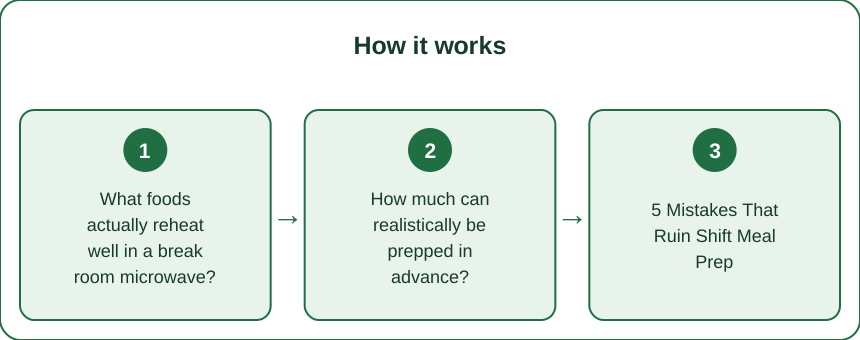
What foods actually reheat well in a break room microwave?
Grain bowls with sauce mixed in before freezing reheat evenly because the sauce keeps rice or quinoa from drying out. Soups and stews are nearly foolproof — liquid distributes heat evenly and nothing separates.
Avoid breaded or fried items (go soggy), delicate greens (wilt to mush), and dairy-heavy sauces (can separate or curdle unevenly in a microwave).
How much can realistically be prepped in advance?
Batch-cook one grain, one protein, and one vegetable on a day off — enough for 4-5 shifts — then mix-and-match into containers rather than making 5 separate full recipes. This cuts prep time to about 45 minutes for a week’s worth of shift meals.
Freeze half the batch; a 12-hour shift often means grabbing whatever’s closest, and having both fridge-ready and freezer-ready options covers unpredictable schedules.

5 Mistakes That Ruin Shift Meal Prep
1. Packing food that needs stovetop finishing. If it’s not fully cooked and microwave-reheatable, it won’t get eaten — you won’t have the setup.
2. Forgetting a vented container. Non-vented lids trap steam and turn food soggy or explode slightly in the microwave.
3. Over-seasoning delicate herbs before freezing. Fresh herbs go bitter after freeze-reheat; add them fresh if possible, or use dried spices instead.
4. Packing large portions. A rushed 15-minute break doesn’t allow for a huge meal — smaller, calorie-dense portions get finished; large ones get abandoned half-eaten.
5. No backup snack. Breaks get cancelled. A shelf-stable backup (nut butter packet, protein bar) prevents a full shift on empty.
What Nobody Tells You About Eating on Shift
The meal that gets eaten is the one requiring zero decisions in the moment — grabbing, heating, eating, done. Elaborate, beautiful meal-prep photos rarely survive contact with a real 12-hour shift; the nurses who eat consistently are usually the ones with the most boring, repeatable rotation of 3-4 go-to meals.
Also: eating something (even imperfect) beats skipping entirely for blood sugar and focus through the back half of a shift.
FAQ: Nurse Shift Meal Questions, Answered
How long is shift meal prep good in the fridge?
Most cooked grain-protein-vegetable combos hold safely for 3-4 days refrigerated; freeze anything you won’t eat within that window.
What if there’s no microwave access at all?
Cold options like grain salads with vinaigrette (not creamy dressing), wraps, and overnight oats travel well without any reheating needed.
Is it okay to eat the same meal every shift?
Completely fine nutritionally if it’s balanced — repetition is often what makes shift eating sustainable rather than a weakness to fix.
TL;DR:
- Grain bowls with sauce mixed in and soups reheat most reliably
- Batch one grain, one protein, one vegetable — mix into varied containers
- Skip breaded, fried, or delicate-green meals — they don’t survive reheating
- A boring, repeatable rotation beats an elaborate meal that never gets eaten
Keep Reading
This article is for general informational purposes only and is not medical advice. Always consult a qualified health professional for guidance specific to you.