Compassion Fatigue in Nursing: Recognizing the Cost of Caring and Refilling the Well

Quick Answer: Compassion fatigue is the emotional depletion that comes specifically from caring for suffering people, and it’s different from burnout — burnout is driven by workload and staffing, while compassion fatigue is driven by the relationships and losses you carry from patients and families. It’s treatable with early recognition, boundary rituals, grief processing, and professional support when needed.
Note: this article covers a mental and emotional health topic. It’s meant for general awareness, not diagnosis or treatment — if what you read here sounds like you, talk to a counselor, your employee assistance program, or another mental health professional.
You clock out, get in your car, and realize you’re still holding the family from room 12 — the one who couldn’t stop crying, the one whose face you’ll see again tonight when you try to fall asleep. That’s not weakness. That’s the specific, real cost of caring for people who are suffering, and it has a name.
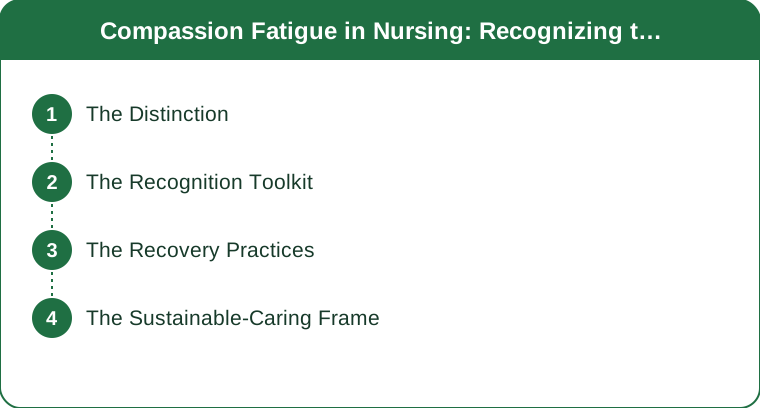
What’s the difference between compassion fatigue and burnout?
They’re related but not the same thing, and mixing them up makes both harder to treat.
Burnout is mostly system-driven — it comes from workload, understaffing, and bureaucracy grinding you down over time. Compassion fatigue is relationship-driven — it comes from the patients you’ve grieved with and the families you’ve held through the worst day of their lives. On hard units, both can be happening to you at once, which is exactly why it’s worth telling them apart: they need different fixes.
What does compassion fatigue actually feel like?
The core of it is empathy that starts to numb — patients begin to feel like tasks instead of people. Other common signs include:
- Intrusive memories from a shift that resurface later, uninvited
- Dread before a shift that used to feel routine
- Irritability at home that spills over from work
- A scary flatness — the “I don’t feel anything anymore” moment that worries a lot of nurses when it first shows up
If any of that sounds familiar, you’re not broken — you’re showing the signs of an occupational exposure, not a personal failing.
Who’s most at risk for compassion fatigue?
Somewhat counterintuitively, the most empathic nurses are the most vulnerable. Compassion fatigue is evidence you care deeply, not evidence that you don’t care enough. It shows up more concentrated in units where suffering and loss are a daily reality — oncology, the ICU, the ED, and hospice in particular.
Naming it as an occupational injury rather than a personal weakness matters, because injuries get treated. Weakness just gets hidden.
How do you catch compassion fatigue early?
Run a monthly self-check
A brief, honest check-in with yourself once a month is enough to catch a trend before it becomes a crisis. The ProQOL self-assessment is a free, anonymous, validated tool built for exactly this — it takes about 10 minutes.
Know your personal top three warning signs
Everyone’s early-warning list looks a little different, but common ones include sleep changes, dreading your shifts, feeling numb toward patients, catching yourself being more cynical than usual, and irritability spilling into your home life. Pick your personal top three in advance so you recognize them fast when they show up.
Lean on your work friends
Colleague check-ins catch things self-assessment misses. A simple workplace culture of “hey, you okay?” is genuinely effective detection — friendship at work isn’t just nice to have, it’s protective.
Listen to your body
Tension, appetite changes, and exhaustion that sleep doesn’t fix are your body voting on how you’re doing, often before your mind catches up.
Know when to get professional support
If you notice intrusive symptoms, a real decline in how you’re functioning day to day, or leaning on substances to get through it, that’s the line where professional support should be engaged — not endured. A therapist, counselor, or your EAP can help you get ahead of it.

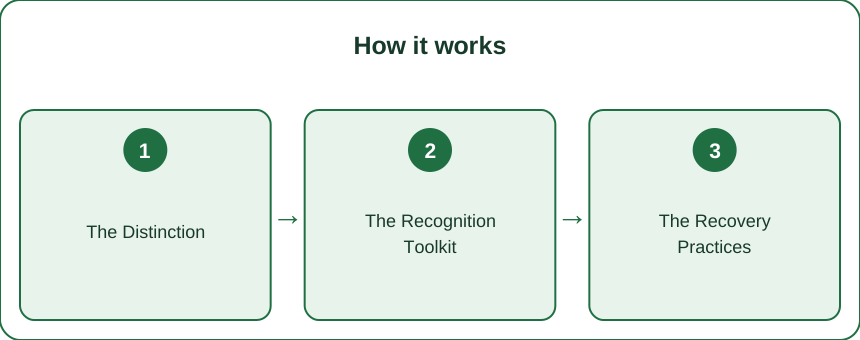
What actually helps you recover from compassion fatigue?
- Boundary rituals. A deliberate shift-end transition — washing your hands as a symbolic release, decompressing on the commute, taking off your scrubs as a hard “off” switch — leaves the suffering at work instead of carrying it home by default.
- Grief hygiene. Acknowledge patient losses instead of stockpiling them. Attend unit debriefs when they’re offered, and give yourself a private moment to process a hard loss rather than pushing straight to the next patient.
- Refill through connection. Family time, friendships, and time with pets or in nature all genuinely replenish empathy. The caring you receive has to balance the caring you give out, or the math doesn’t work long-term.
- Reconnect with your “why.” Keep thank-you notes. Journal the moments that reminded you why you became a nurse in the first place. Research on this points to meaning as one of the strongest antidotes to compassion fatigue there is.
- Use professional support without shame. EAP counseling, trauma-informed therapists, and peer-support programs exist specifically for this. Using them is a sign of professional maturity, not failure.
- Don’t skip the basics. Sleep, movement, and nutrition are the floor everything else stands on — a depleted body has no empathy reserves left to lend anyone, including your patients.
What Nobody Tells You About Sustainable Caring
- Boundaries don’t make you a worse nurse — research suggests they make your care better, not less compassionate. Caring fully at the bedside and deliberately releasing it afterward is a skill, not a betrayal of your patients.
- Individual recovery only goes so far if the system doesn’t change. Advocating for realistic assignments and staffing isn’t separate from your own recovery — it’s part of it.
- You’re allowed to rotate. Unit changes, per-diem seasons, or bridging into an education role are legitimate ways to manage your exposure across a whole career, not signs you couldn’t hack it.
- You need an identity beyond the badge. This is the one that surprises even veteran nurses: the hobbies, relationships, and roles that have nothing to do with nursing are often what determines whether you make it through a brutal season intact.
Quick Questions About Compassion Fatigue in Nursing
Is compassion fatigue the same thing as burnout?
No. Burnout is mostly driven by workload and system pressures like staffing and bureaucracy. Compassion fatigue comes specifically from the emotional cost of caring for suffering patients and families — though on hard units, you can experience both at the same time.
Can compassion fatigue go away on its own?
Sometimes early symptoms ease with rest and boundary-setting, but ongoing exposure without any recovery practices tends to make it worse, not better. If symptoms are intrusive or affecting your daily functioning, it’s worth talking to a counselor or your EAP rather than waiting it out.
Which nursing specialties have the highest risk of compassion fatigue?
Units with concentrated exposure to suffering and loss — oncology, the ICU, the emergency department, and hospice — tend to see it most. That said, any nurse in any specialty can experience it; high empathy is the bigger risk factor than the unit itself.
TL;DR
- Compassion fatigue comes from caring for suffering people; burnout comes from workload and systems — they’re different, though they can overlap
- The most empathic nurses are the most at risk, and that’s a sign of caring, not weakness
- Catch it early with a monthly self-check, a known personal warning-sign list, and honest colleague check-ins
- Recover with shift-end boundary rituals, grief hygiene, connection outside of work, and reconnecting with your “why”
- Use professional support (EAP, therapy, peer programs) without shame — it’s part of sustainable caring, not a failure
- This is general information, not medical or mental health advice — talk to a professional if this sounds like you
Keep Reading
This article is for general informational purposes only and is not medical advice. Always consult a qualified health professional for guidance specific to you.